How to Compare Concrete Driveway Estimates: What Factors Should I Consider When Comparing Costs From Different Contractors
What Should I Look for in a Concrete Driveway Estimate
Comparing concrete driveway estimates requires examining slab thickness, base preparation, and finish type. American Custom Concrete notes that 4-inch slabs suit standard vehicles, while heavier trucks demand thicker concrete. Understanding the concrete driveway cost factors behind each line item helps homeowners read concrete driveway quotes with confidence. Prices in Fredericksburg vary by project complexity and finish type, with decorative finishes costing more.
Key Takeaways
Slab thickness must match vehicle profile, with 4 inches for standard vehicles and 5 to 6 inches for heavy trucks or RVs.
Base preparation requires professional grading and a strong gravel base to prevent settling and cracking over time.
Climate-specific reinforcements like expansion joints address freeze-thaw cycles that cause premature driveway failure.
Per-square-foot pricing varies in Fredericksburg, with decorative finishes and thicker slabs commanding higher rates.
What Should I Look for in a Concrete Driveway Estimate?
Homeowners comparing bids from different contractors need line-item detail to avoid paying for shortcuts that fail within a few seasons. A concrete driveway estimate should specify slab thickness, base preparation, and climate-specific reinforcements. Running each bid through a concrete contractor estimate checklist makes these gaps easy to spot before signing.
What Factors Should I Consider When Comparing Concrete Driveway Costs From Different Contractors? Start with the structural specifications. A standard residential driveway is typically 4 inches thick, which works well for passenger vehicles and light SUVs. Homes with pickup trucks, large SUVs, or RVs require a thicker slab of 5 to 6 inches to prevent cracking. An estimate that omits thickness invites premature failure.
What Thickness Does the Estimate Specify? (Concrete Driveway Thickness Requirements)
1️⃣ Confirm the slab thickness matches the household’s vehicle profile.
2️⃣ Verify that heavier vehicles trigger a 5 to 6 inch specification.
3️⃣ Reject any bid that lists only a generic “standard driveway” without dimensions.
American Custom Concrete provides a detailed guide on concrete driveway thickness for SUVs, trucks, and work vehicles. The company’s estimates account for local conditions that generic bids overlook.
What Site Preparation Does the Bid Include?
Freeze-thaw cycles in Northern Virginia demand thicker slabs and expansion joints to prevent cracking. Clay and uneven ground require professional grading and a strong gravel base for driveway stability. A low bid that skips grading or base work shifts long-term repair costs onto the homeowner.
Estimate Element
What to Verify
Slab thickness
4 inches standard; 5 to 6 inches for heavy vehicles
Base preparation
Professional grading plus strong gravel base
Climate reinforcement
Expansion joints for freeze-thaw cycles
Contractors who itemize these elements demonstrate accountability. Vague language about “standard installation” hides the structural decisions that determine whether a driveway lasts decades or cracks within years.
How Do I Compare Sub-Base and Reinforcement Details?
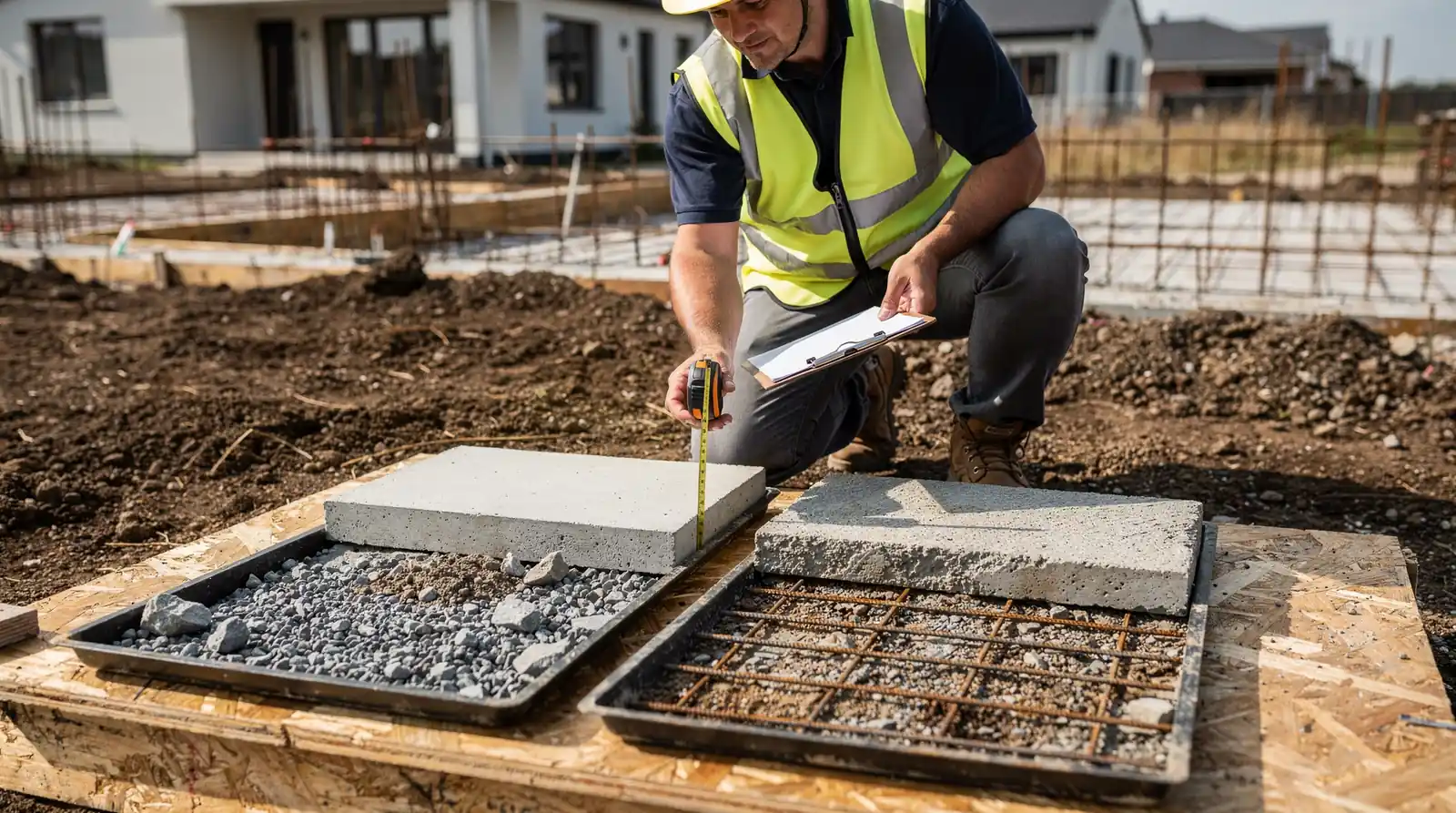
Comparing contractor bids demands a close look beneath the surface. The sub-base and reinforcement plan determines whether a driveway remains crack-free for decades or fails within a few seasons.
Sub-base preparation is critical for long-term driveway performance. A properly prepared base, combined with control joints, enables a 4-inch slab to perform reliably for decades. A contractor’s proposal should specify the aggregate material, depth, and compaction method. Vague language like “stone base” warrants immediate clarification.
Soil conditions in Stafford’s clay-heavy terrain make this especially urgent. Without adequate grading and compaction, driveways settle and crack during the region’s freeze-thaw cycles.
What Should a Reinforcement Plan Include in a Concrete Driveway Bid?
Reinforcement details distinguish a durable driveway from a short-term solution. Thicker concrete distributes weight more effectively and reduces stress on the slab. This prevents cracking and settlement under heavy vehicles. Bids listing a 4-inch slab for passenger cars need an upgrade specification for truck or RV traffic.
Wire mesh or rebar spacing, gauge, and placement should appear explicitly in the contractor’s line items. Missing reinforcement details signal corner-cutting that surface-level finishes later conceal.
How Does Local Soil Affect Driveway Sub-Base Requirements?
Stafford’s clay-heavy soils and rolling terrain make driveway construction a job for experienced professionals. A reinforced, properly graded concrete driveway stays stable through freeze-thaw cycles and everyday use. Contractors unfamiliar with regional soil behavior underestimate the gravel depth needed. Homes on sloped lots require additional engineering. Proposals without soil-specific grading notes should raise immediate concern, no matter the bid’s bottom line.

What Do the Per-Square-Foot Prices Mean
What Do the Per-Square-Foot Prices Mean?
Per-square-foot pricing serves as the baseline for comparing concrete driveway bids. A square-foot rate bundles materials, labor, and basic site preparation into a single figure. Homeowners in Fredericksburg and Northern Virginia pay varying rates per square foot, depending on project complexity and finish type. That range reflects real differences in what each contractor includes. Understanding per square foot concrete driveway pricing this way turns an abstract number into a meaningful comparison tool.
A low per-square-foot quote often omits critical structural elements. The price drops when contractors skip proper base compaction, reduce slab thickness, or eliminate reinforcement. These shortcuts transfer long-term repair costs to the property owner. A higher rate frequently covers the full scope: excavation, gravel base, rebar or wire mesh, control joints, and sealing.
What Does a Basic Broom Finish Driveway Cost?
A standard two-car driveway measuring 20×40 feet (800 sq. ft.) with a basic broom finish carries a price that reflects standard 4-inch thickness and minimal grading. This finish provides a slip-resistant surface suitable for daily residential traffic.
How Much More Do Decorative Finishes Add?
A stamped or decorative finish on the same 800 sq. ft. driveway commands a premium over the basic broom finish. Decorative concrete replicates the look of stone, brick, or tile through stamping patterns and integral color. The premium covers additional labor, coloring agents, release compounds, and sealing. Homeowners comparing bids should confirm whether decorative pricing includes a second color or antiquing release, as these details affect the final appearance.
What Drives the Cost of a Heavy-Duty Driveway?
A heavy-duty reinforced driveway of the same size carries a higher price tag than standard options. This option suits properties with large SUVs, work trucks, or RV parking. The higher cost reflects thicker slabs (5 to 6 inches), heavier-gauge reinforcement, and deeper base preparation. Contractors quoting below the typical range for a reinforced driveway may be reducing material specifications. The company’s concrete driveway installation cost guide for Fredericksburg details how soil conditions and freeze-thaw cycles influence these structural requirements.
The per-square-foot number means nothing without a line-item breakdown. Homeowners must verify slab thickness, base depth, reinforcement type, and finish inclusions before accepting any bid.
How Do I Evaluate Warranty and Contractor Credentials?
A contractor’s warranty and credentials reveal the true commitment behind a driveway estimate. Checking concrete driveway warranty and credentials side by side with the price is what separates a durable investment from a costly gamble. Homeowners who skip this step risk paying twice for the same project when substandard work fails.
What Does a Concrete Driveway Warranty Typically Cover?
American Custom Concrete, Inc. provides a one-year warranty on all work performed. This coverage protects homeowners against installation defects that surface after project completion. A written warranty signals confidence in materials and craftsmanship. Contractors who offer no warranty leave clients exposed to repair costs the moment the crew leaves the property.
Why Do Licenses and Insurance Matter?
The company operates as a licensed and insured contractor. Proper licensing confirms compliance with Virginia’s building codes and trade standards. Insurance protects the homeowner from liability if property damage or worker injury occurs on site. Uninsured contractors transfer that financial risk directly to the client.
How Can Industry Memberships Indicate Quality?
Membership in the Fredericksburg Builders Association and the Better Business Bureau demonstrates ongoing accountability. These organizations require adherence to ethical standards and provide dispute resolution channels. American Custom Concrete, Inc. also holds Angie awards and maintains high-rated reviews from past clients. Third-party recognition offers independent verification that marketing claims match real performance.
Homeowners comparing bids should request proof of all four credentials before signing a contract. A lower price means nothing when the contractor cannot stand behind the work. For a full overview of available services, review the company’s concrete contractors page.
What Hidden Costs Should I Ask About Upfront?
Comparing concrete driveway bids requires more than a glance at the bottom line. Unstated expenses can inflate a project’s final cost by thousands of dollars. Homeowners who skip this scrutiny risk budget overruns and structural shortcuts that compromise long-term durability.
What Permits or Regulations Could Add to My Bill?
Some counties require building permits or stormwater management for large driveways. These regulatory steps add fees that a contractor’s initial quote might exclude. A homeowner should confirm whether the estimate covers all permitting costs before signing any agreement.
How Does Site Access Affect the Final Price?
Limited access for trucks or equipment increases labor time and delivery charges. Narrow driveways, steep slopes, or tight urban lots force crews to use smaller machinery or hand-carry materials. This logistical friction raises the total project cost beyond what a simple square-foot calculation suggests.
Are Decorative Finishes Priced Separately?
A plain gray concrete driveway costs less per square foot than decorative finishes, which include stamped patterns, integral color, or exposed aggregate. Stamped patterns, integral color, or exposed aggregate all carry premium charges that a base bid often excludes. Homeowners should request a line-item breakdown for any aesthetic upgrades.
Does Driveway Size Trigger Minimum Charges?
For smaller driveways, concrete is typically the cheaper option compared to asphalt once mobilization fees and project minimums enter the calculation. Small projects still incur equipment transport and crew setup costs. A contractor’s minimum charge can erase the apparent savings of a compact footprint. Asking about these thresholds upfront prevents a surprise line item on the final invoice.
Frequently Asked Questions
What slab thickness should I look for in a concrete driveway estimate?
A standard residential driveway is typically 4 inches thick for passenger vehicles. Homes with pickup trucks, large SUVs, or RVs require a thicker slab of 5 to 6 inches.
What site preparation details should the bid include?
The bid should specify professional grading and a strong gravel base for driveway stability. Expansion joints for freeze-thaw cycles are also necessary in Northern Virginia.
How do I compare sub-base and reinforcement details between contractors?
Proper base preparation combined with control joints enables a 4-inch slab to perform reliably for decades. Reject bids with vague language about “standard installation” that hide structural decisions.
Conclusion
Comparing concrete driveway estimates comes down to verifying slab thickness, base depth, reinforcement, and finish inclusions against the contractor’s warranty, license, and insurance. A low per-square-foot number hides structural shortcuts or unstated permit and access fees. Homeowners who request a line-item breakdown and confirm credentials before signing avoid paying twice for substandard work.